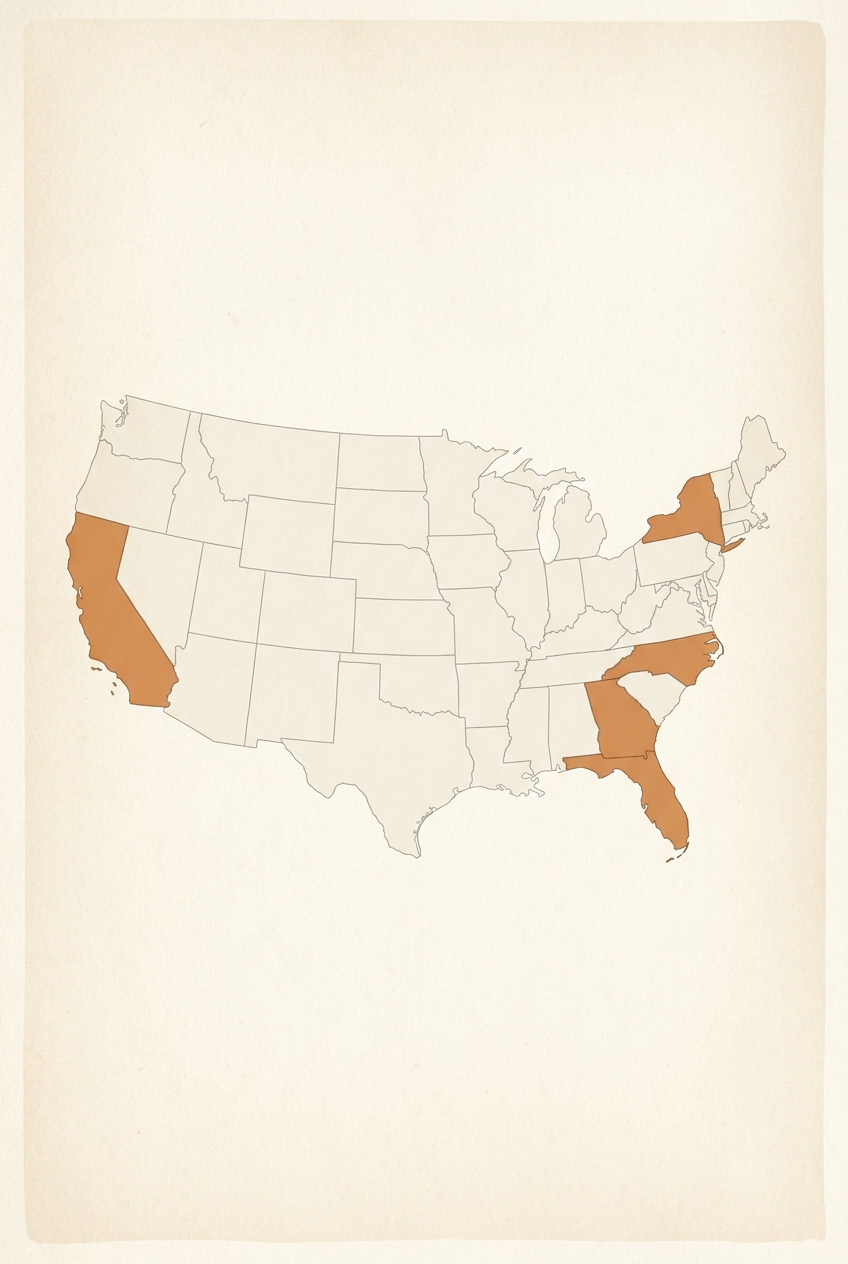
There is a map on the wall of our office. It has five states colored in.
California. Georgia. Florida. North Carolina. New York.
That is where DAR.WIN is running pilots today. It is not a marketing footprint. It is not a press-release map. It is where real homes, with real residents, are using the system right now while we listen, learn, and refine.
We picked these five states on purpose. Each one is teaching us something different.
Georgia
We started here. Georgia is home. It is where the company was founded, where the first installs went in, and where our team can drive to a kitchen table in under an hour. The Atlanta to South Georgia corridor is dense with active adult communities, and the families we are working with here have been generous with their time and brutally honest with their feedback. Every product decision we make is shaped by what we hear in Georgia first.
Florida
Florida is the deep end of the pool. More seniors live independently here than in any other state. The communities are larger, the family relationships are more often long-distance, and the urgency around aging in place is more concrete because the alternative, assisted living, is also more expensive and more saturated. Florida is where we are learning what scale feels like.
North Carolina
North Carolina is the corridor in miniature. The Research Triangle and the Charlotte metro are growing quickly with retirees from the northeast, and many of them are arriving with adult children still living in Boston, New York, or DC. That distance changes the conversation. The North Carolina pilots are teaching us what DAR.WIN looks like when the family is 800 miles away.
New York
New York is the urban test. Most of our early thinking centered on single-family homes with predictable rhythms. New York pilots are running in apartments, in co-ops, condos, and pre-war buildings where the floor plan is smaller, the routine is denser, and the family is often one borough away rather than one state away. Different environment, same question: who is okay, and how do we know.
California
California is the bridgehead. The west coast aging-in-place market is enormous and has very different cultural expectations around privacy, technology, and family involvement. We are running a small number of California pilots specifically to test whether the things we learned on the east coast translate. Early signs say yes, with adjustments. We will know more by the end of the summer.
What we are actually measuring
Across all five states we are tracking the same handful of things.
We are tracking how often residents stop the system from running. Almost never. That tells us the no-cameras, no-wearables choice was the right one.
We are tracking how often the family checks the dashboard. More than we expected. That tells us the value is not just in alerts. It is in the everyday peace of mind.
We are tracking what we get wrong. Plenty, but less every week. Every false signal teaches us something. Every missed signal teaches us more.
We are tracking what residents tell their neighbors. Word of mouth in a 55+ community travels faster than any ad we will ever buy.
What we are not doing
We are not publishing customer names. We are not running television ads. We are not claiming results we have not earned. The pilots are pilots. The point is to listen and learn, not to perform.
When the pilots become products at scale, we will say so. Until then, the five colored states on the wall are a reminder of how much there still is to figure out.
What is next
We will share what we learn as we learn it. Some of it will be encouraging. Some of it will be uncomfortable. Honest is the only setting we know how to run on.
If you are reading this from one of the five states and want to know more, the door is open. If you are reading from somewhere else, the map will be growing. Quietly. One household at a time.