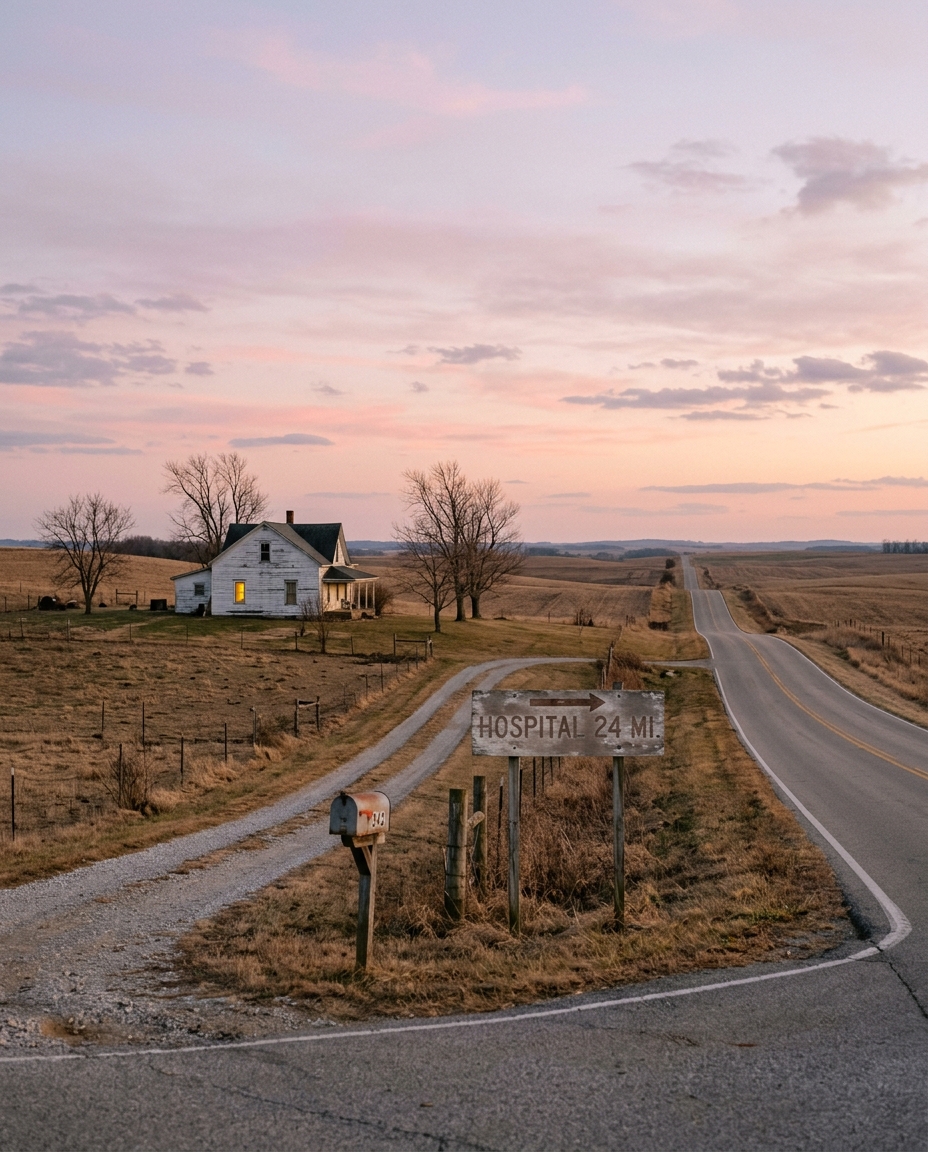
More than 100 rural hospitals have closed in the United States over the last decade. Eighteen more closed or stopped offering inpatient care this year alone. Another 300 are at immediate risk. Seven hundred more are on the watch list.
That is the picture Boston University’s School of Public Health painted in a recent report. The phrase that stayed with us was from Dr. Timothy Callaghan, one of the article’s experts: "The loss of a rural hospital is devastating for a local community."
He is right. And the part that does not get said enough is who is most affected.
The math of a closure.
The average rural resident already drives twice as far as an urban resident to reach medical care. About 18 miles on a good day. When the local hospital closes, that number doubles, sometimes triples. The next hospital might be 40 miles away. An hour on a two-lane road in good weather. Longer in the dark, in the rain, in the snow.
For a healthy 35-year-old, an extra 30 minutes in an ambulance is uncomfortable. For an 80-year-old having a stroke, it is the difference between recovery and a wheelchair. For an 80-year-old who falls and cannot get to the phone, those 30 minutes do not even start counting until someone notices she is missing.
This is the part of the story the article touches on but does not dwell on. Rural America is aging. The communities losing their hospitals are the same communities with the highest concentration of people over 75. The people who most need fast access to emergency care are the ones living the furthest from it.
What gets lost with the hospital.
When a rural hospital closes, the town loses more than a building. It loses the doctors who lived there. The pharmacy that anchored the main street. The home health agency that staffed out of the hospital. The physical therapy office. The lab. The radiology suite. The 24-hour place a worried daughter could call at 2 AM.
What also goes away, quietly, is the safety net of proximity. The unspoken understanding that if something happened, help was nearby. For an older person living alone in a rural county, that proximity was the thing that made aging in place feel possible. When it disappears, the family conversation shifts. The phone calls get more frequent. The pressure to move closer to a city, or into a facility, starts to build.
For many families, the closure of the local hospital is the moment the question stops being "can Mom stay in her home" and becomes "how long can we keep pretending this is okay."
The time we cannot get back.
The cruel arithmetic of emergencies in older adults is that the clock starts when something happens, not when someone notices. A fall at 6 AM that is not discovered until a neighbor stops by at 4 PM is not a 30-minute problem. It is a ten-hour problem.
In an urban setting with a hospital across town, ten hours of waiting on the floor is bad. In a rural setting with a hospital 45 miles away, ten hours of waiting on the floor is often fatal.
The standard response to this problem has been to ask the senior to wear something. A pendant. A watch. A button on a lanyard. The reality, as anyone with an older parent knows, is that the device ends up in a drawer. Or on the dresser. Or sitting on the kitchen counter the morning of the fall.
What is needed in rural America is not another device for grandma to forget to wear. What is needed is a home that already knows.
What awareness buys.
DAR.WIN does not call an ambulance. It does not replace a hospital. It does not bring back a labor and delivery ward that has been closed.
What it does is this. It watches the rhythm of the home, quietly, in the background, with no cameras and no wearables. It learns when the morning routine should start. It notices when it does not. It tells the family what they need to know before the silence becomes a tragedy.
In a town with a hospital 10 minutes away, that early notice is helpful. In a town where the nearest ER is 45 minutes away and the next-door neighbor is half a mile down the road, that early notice is the difference between a phone call and a funeral.
If you are 75 and your closest hospital just shut its doors, the distance to care has gotten longer. The technology in your home has to get smarter to make up the gap.
What we are building for.
DAR.WIN was not designed for rural America specifically. It was designed for any home where a senior lives alone and a family wants to know they are okay. But the populations most affected by hospital closures are exactly the populations our product was built to protect. Older adults. Solo livers. Adult children too far away to drop by.
The closure of a rural hospital is a policy failure, an economic failure, and a healthcare delivery failure all at once. DAR.WIN cannot fix any of those things. But we can fix the smaller, more immediate problem of a family not knowing what is happening in their parent’s home until it is too late.
When the hospital closes, the home has to know more. That is the work we are doing.