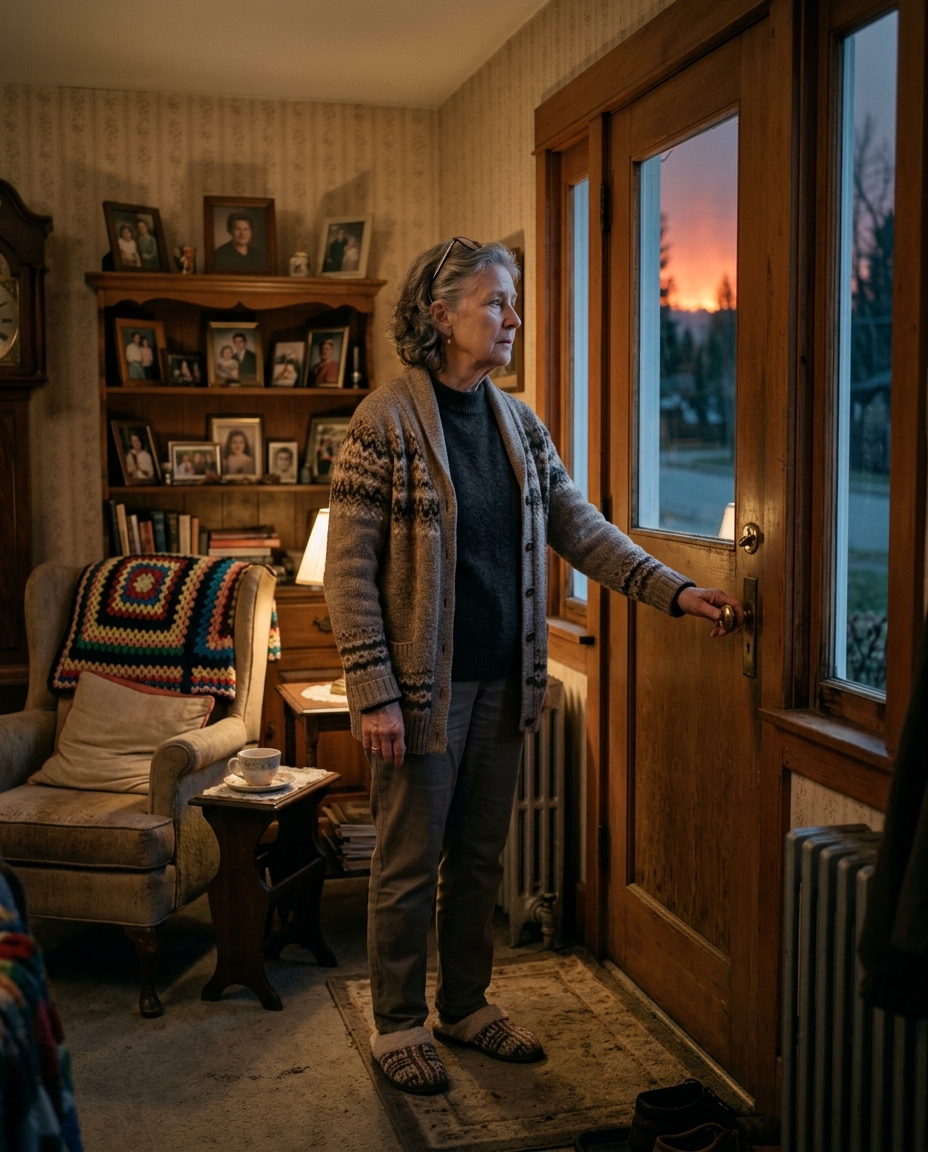
In a wildfire, a hurricane, or a building fire, evacuation is the moment everything depends on knowing who is still inside. For seniors who live alone, that question often does not get answered until it is too late.
Every emergency manager knows the same problem. The order goes out. The buses roll. The neighborhood empties. And somewhere on the block, in a house that looks just like the others, an 82-year-old woman is sitting at her kitchen table with the television off because the power went out an hour ago, and no one knows she is there.
She did not get the reverse 911 call because her landline was disconnected last year. She did not see the alert on her phone because she does not carry it in the house. Her daughter is in Boston. Her son-in-law is two states over. The deputy who knocked on her door knocked once, did not hear anything, and moved to the next house because there were forty more to clear before the road closed.
She is one of the people the system was not designed for.
The visibility gap.
Emergency response runs on assumptions. Houses with cars in the driveway are assumed occupied. Houses with lights on are assumed occupied. Houses that look dark are assumed empty. None of these assumptions work for an older adult living alone with the curtains drawn, the lights off to save money, and a car they have not driven in six months.
After the Lahaina wildfire, the most painful conversations in the after-action reports were about elderly residents who were known to live alone but whose status was unknown for hours or days after the fire passed. The conversations were not about the fire. They were about the gap between the order to evacuate and the confirmation that everyone got out.
That gap is where DAR.WIN lives.
What the home knows.
The technology is not complicated to explain. Four small plugs in the wall. They sense motion using the WiFi signal that is already in the house. They learn the rhythm of the home over a few days. After that, the home knows the difference between empty and occupied. Active and still. Moving and not moving.
In an evacuation, that signal becomes invaluable. A family member can open the app and know in five seconds whether their parent is still in the house. A property manager at a 55+ community can pull up a dashboard and see, by unit, who has left and who has not. An emergency coordinator with permission and the right integration can know which homes still need a knock on the door.
This is not surveillance. There are no cameras. There is no audio. The only thing the system reports is whether a home is occupied or not, and whether the activity in it looks normal or has stopped. That is the signal that matters.
For families. For communities. For first responders.
For families: in the moment when you cannot reach your mother because the cell tower is down or her phone is dead, the home can still tell you she is there or she is not. That is the answer you need to make the next decision — drive down, call a neighbor, call the sheriff.
For 55+ communities and senior apartment buildings: a lifestyle director or property manager with a dashboard view across their occupied units can produce an evacuation status report in minutes, not hours. They can point first responders to the units that have not cleared. They can call the families of residents whose homes still show activity.
For first responders: with the right integrations and consent, DAR.WIN can be one more signal in the decision-making layer. Not a replacement for the door knock. A way to make the door knock more targeted.
“In an evacuation, the question is not whether the order went out. The question is whether everyone heard it.”
The 82-year-old at the kitchen table.
Go back to her. The fire is two miles away. The neighborhood is emptying. She is sitting at her kitchen table because the power went out and she does not know what else to do.
Her daughter in Boston opens the DAR.WIN app. She sees that the home is occupied and active. She calls the sheriff. She gives them the address. She tells them her mother is still inside, she is mobile, she needs a ride out. The deputy who would have skipped the house comes back. The door opens. Her mother gets in the truck.
That is the difference between a system that assumes empty and a system that knows.
We did not build DAR.WIN for emergencies. We built it for the everyday — the small drift, the slow decline, the night when something is off and no one is there to notice. But the same signal that helps a family catch a slow change is the signal that helps everyone find their loved one in a fast one.
When the sirens come, the home should already be talking.